
Life has a way of shifting without warning. One season you feel settled, and the next, everything looks different—a job gone, a relationship over, a move across the country, a diagnosis that rewrites your plans. Major life transitions are universal, but that doesn't make them easy. The people who come out the other side aren't the ones who avoided the hard stuff. They're the ones who learned how to move through it.
Quick Takes
Major life changes, from job loss to grief, require both emotional processing and practical action.
Career setbacks can open the door to entrepreneurship and self-directed work.
Relationship transitions and relocations both require rebuilding identity and community.
A step-by-step approach to change reduces overwhelm and creates forward momentum.
The right support systems, tools, and mindset shifts determine how well you recover and grow.
The Changes That Hit Hardest
Not all transitions are created equal. Some arrive with time to prepare. Others don't. Here are the life changes that tend to challenge people the most:
Job loss or a major career setback
Divorce or the end of a long-term relationship
The death of someone close
A serious health diagnosis, for yourself or a loved one
Relocating to a new city or country
Becoming a parent or taking on a caregiving role
Each of these carries its own emotional weight, but they share a common thread: they force you to rebuild something, whether that's your routine, your identity, or your plans for the future.
How to Actually Move Through a Major Transition
Knowing change is hard doesn't tell you what to do next. This step-by-step approach works across most major life transitions:
Name what you're experiencing. Denial delays recovery. Identifying the transition clearly is step one.
Let yourself grieve what's lost. Every change involves loss of some kind, even the changes you chose.
Stabilize your immediate environment. Focus on sleep, basic routines, and one or two reliable people.
Separate what you can and can't control. Energy spent on the uncontrollable is energy wasted.
Set one small, concrete goal for the week. Momentum is built in small steps, not giant leaps.
Seek professional support if needed. Therapists, financial advisors, and career coaches all exist for moments like this.
Revisit your identity outside the thing that changed. You are more than your job, your relationship, or your address.
Grief, Diagnosis, and the Changes You Didn't Choose
Some transitions are chosen. Others arrive without consent. Losing someone you love, receiving a health diagnosis, or watching a parent's health decline are experiences that demand a different kind of navigation.
The throughline in all of them is this: the goal is not to return to who you were before. That version of your life is gone. The work is figuring out who you are now and what this chapter asks of you. Grief doesn't follow a schedule. Caregiving doesn't come with a manual. A diagnosis reorders everything you thought was settled. What helps most is honest support, accurate information, and the permission to not have answers yet.
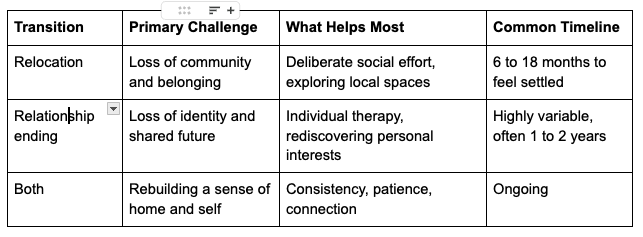
Relocation and Relationship Endings at a Glance
Both moving to a new place and ending a long relationship involve a specific kind of disorientation: the loss of the familiar. This comparison covers what to expect from each.
FAQ
How long does it take to adjust to a major life change?
Adjustment timelines vary widely depending on the type of change, your support system, and your previous experience with transitions. There is no universal timeline, and comparing your pace to someone else's rarely helps. The most useful measure is whether you're moving, pace aside, rather than staying stuck.
Is it normal to feel relief and grief at the same time?
Yes, and it's more common than most people expect. Ambivalent feelings during transitions, such as sadness over a divorce alongside a sense of freedom, are a normal part of processing complex change. Emotions don't follow logical rules, and feeling two contradictory things at once doesn't mean something is wrong with you.
When should someone seek professional help during a life transition?
Professional support is worth considering any time a transition begins to interfere with your ability to function day to day. Signs include persistent sleep disruption, withdrawal from relationships, difficulty making basic decisions, or feelings of hopelessness that don't lift. A therapist or counselor can provide structure when everything feels structureless.
Can a major setback actually lead to something better?
For many people, yes. Research on post-traumatic growth suggests that adversity can lead to measurable positive change in areas like relationships, self-perception, and sense of purpose. This doesn't mean the hard thing wasn't hard, or that positive outcomes are guaranteed. It means that people are more adaptable than they often give themselves credit for, and that new directions sometimes only become visible after the old ones close.
What's the biggest mistake people make during a major life transition?
The most common mistake is rushing the process to avoid discomfort. Skipping the emotional processing phase, jumping immediately into major decisions, or forcing positivity before it's genuine all tend to backfire. Transitions need time to settle before the path forward becomes clear. Sitting with uncertainty, as uncomfortable as it is, is often the most productive thing you can do in the early stages.
Moving Forward Looks Different for Everyone
Major life changes are not problems to be solved on a deadline. They're passages, and passages take time. Whether you're rebuilding after a loss, starting over professionally, or adjusting to a life that looks nothing like the one you planned, the direction forward exists. You just have to keep moving long enough to find it.
